Your website is doing four jobs. AI website builders nail two.
AI website builders aren't killing agencies. They're sorting which small businesses were buying one out of habit and which ones actually needed the work. The dividing line isn't budget. It's which of four jobs your site is doing.
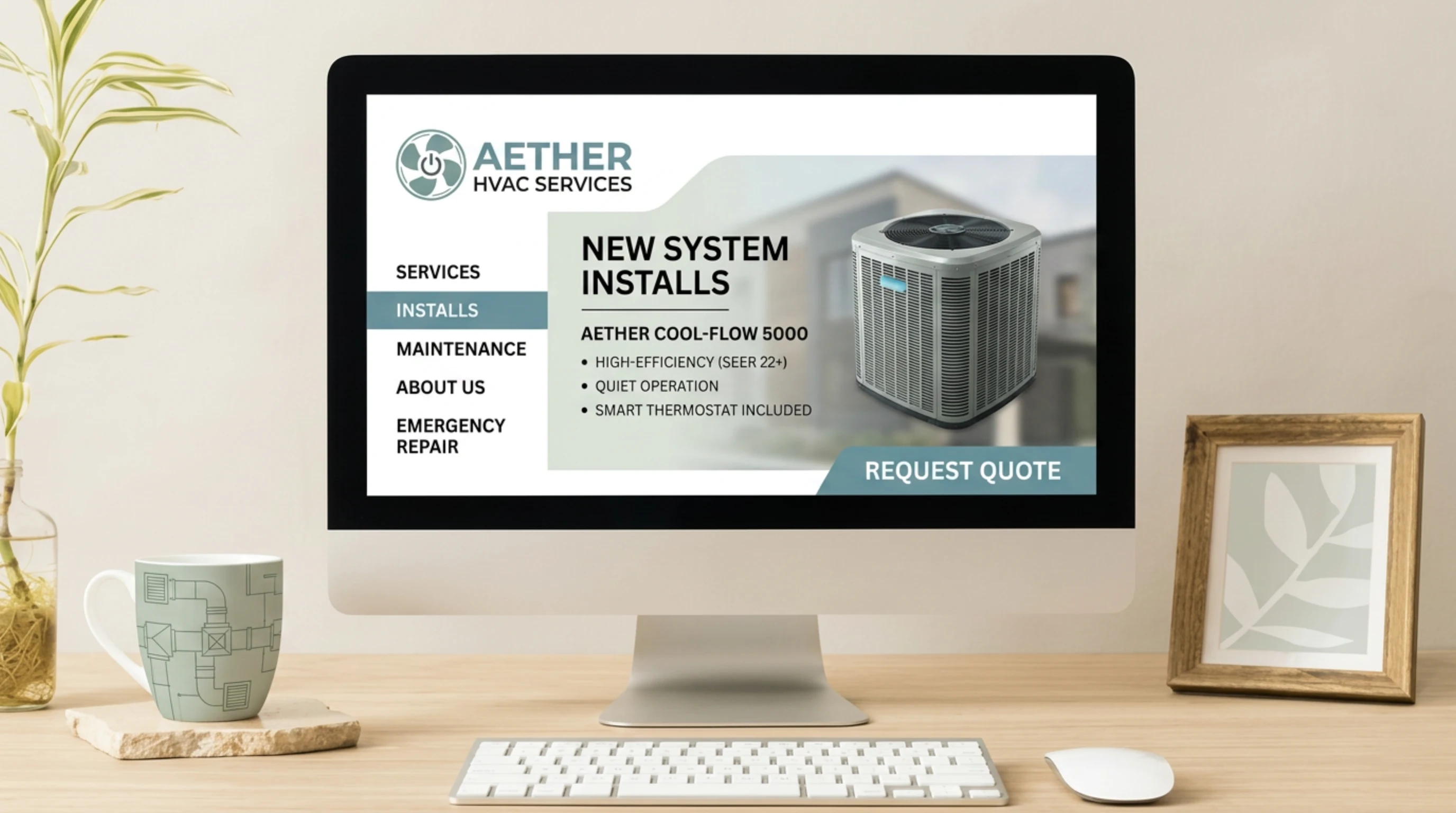
A founder pays for Lovable on a Saturday morning. By Sunday night her business has a website. It loads fast, it looks coherent, it has her real photos and her real copy, and the contact form goes to her real inbox. Monday morning she sends the link to her partner and asks, half rhetorical, why anyone still hires an agency for this.
The honest answer is that most people probably don't anymore. The other honest answer is that for her specific business, this might be the best $20 she has ever spent on marketing, or it might be a quiet mistake she won't notice for ninety days. Both stories are common right now. The difference between them has almost nothing to do with the tool.
The takes have been wrong in both directions
The discourse around AI website builders has settled into two camps fast, and both of them are off.
- 'Agencies are dead.' They aren't. The agencies built around 'we charge $8,000 for a five-page WordPress site' are dead, or will be, but those agencies were always selling a markup on a template. Their problem is that the markup is now visible.
- 'AI builders ship slop.' Some do. Most of what comes out of Lovable, Bolt, or Base44 today is well past the floor of what a mid-tier agency was charging for in 2022. The output is not the problem. Where it fits in your business is.
What's actually happening is sorting. AI builders are revealing which small businesses were buying an agency website out of habit or status, and which ones were buying it because they needed something specific. The first group should stop. The second group should be careful before they do.
Your website is doing one of four jobs
Before you can decide whether the weekend website is the right call, you have to name what the site is for. Every SMB website is doing some mix of four jobs, and each one has a different tolerance for the AI-built approach.
1. Brochure
The static stuff. Who we are, what we do, where we are, hours, photos, a phone number. Most of the traffic is people who already know your name and want a fact. The page exists so they can confirm you're real, find the address, and call. This job is almost embarrassingly easy now. Lovable, Bolt, and Base44 do it well, and the work an agency does on top of them is mostly aesthetic polish.
2. Lead capture
Forms that go to inboxes, click-to-call buttons that route to phones, booking flows that put time on a calendar. The job is to convert intent into a conversation. Done well, it leaks fewer leads and qualifies them before a human burns time. Done badly, it gives you a steady drip of garbage submissions and a slow inbox. AI builders ship something here, but they ship the easy version: a form that works on the happy path. The hard version (de-duplication, source tracking, qualifying logic, after-hours routing, the part where the lead actually closes) is custom work whether you generate the page or not.
3. Operational surface
The site is the front door to something that lives inside your business: a customer portal, a job tracker, a pricing configurator that hits real inventory, a scheduling system tied to dispatch. This is no longer a website in the marketing sense. It's a product, and the marketing site is the entrance. AI builders are not the right tool for the product. They're acceptable for the entrance, but you'd better have a clean seam between the two before you start.
4. Trust signal in a high-trust category
Legal, medical, financial, anywhere a customer is about to hand you money or risk to solve a problem they don't fully understand. The website is not communicating information. It is communicating that you are the kind of organization that can be trusted with the work. The visual language, the typography, the photography, the words: they all carry that signal. AI builders default to a competent, generic, design-system look. In categories where competent and generic is the floor, that's fine. In categories where the floor is 'this looks like a serious firm,' competent and generic reads as suspicious.
When the weekend website is the right call
Three honest cases.
- Your site is brochure-dominant and your business is referral-dominant. Most of your customers arrive already knowing your name. The website's job is to confirm reality and surface a phone number. Hire the agency for your storefront, not your URL.
- You're pre-product-market-fit. You don't know what your site needs to say in six months. Shipping a $20,000 site you'll rewrite twice is theatrical. Ship the weekend version. Spend the difference on customer research.
- The realistic alternative is a $4,000 agency that will ship something similar in eight weeks. Be honest about which agency you would actually hire at your budget. If it's a shop selling 'premium WordPress,' the AI builder usually wins on every axis except invoice prestige.
Four times the weekend website costs you a quarter
Same structure, opposite verdict. Four cases where the speed is the trap.
1. The site is a qualifier for your sales process
If your site is making decisions before a human sees the lead (routing by service line, scoring by zip code, asking the question that tells you whether this is a real customer or a tire-kicker), you are not building a website. You are building the front of a funnel. AI builders give you a form. They do not give you a funnel. The pages will look fine. The economics will quietly underperform what custom work would do, and you won't notice because there is no counterfactual.
2. You're in a high-trust category and the floor is higher than the tool's default
If your customer is choosing a lawyer, a wealth manager, a surgeon, or a B2B vendor for a contract above $50k, the design has to do work the AI builder doesn't know to do. Photography of real people. Type that signals seriousness without coldness. White space that says expensive without saying empty. None of that is impossible to coax out of an AI builder, but you have to know precisely what you're asking for, and at that point you've reinvented the agency engagement in a less efficient form.
3. The site has to integrate with systems you actually run on
CRM sync, inventory checks, calendar availability against real staff schedules, customer portals that read from your operational database. Each of these is its own project. AI builders will give you a button that says 'Book a call' and an embed of someone else's calendar. That is fine until your dispatcher is on the phone telling a customer the slot they booked isn't actually available. By the time you're asking 'how do I make Lovable talk to our scheduling system,' you should be talking to a builder, not a generator.
4. Performance, SEO, and GEO are load-bearing for the business
If your business depends on the site being findable, and on being one of the pages an answer engine cites when a customer asks a question, the marginal points of Core Web Vitals, the structured data, the passage-shaped content, the hosting choices that determine TTFB, all of it matters in compounding ways. AI builders ship sites that pass the basic checks and fail the marginal ones. For a business where the marginal points are the difference between page one and page three (or between getting cited by ChatGPT and not), the difference is real money over the year. Most of what we wrote in the GEO piece is harder to ship on a weekend-built site than on one built for it from the start.
A diagnostic you can run today
Three questions, in this order.
- Name the jobs. Take the four jobs above and assign a percentage to each. Roughly how much of what your website does is brochure, capture, operational surface, and trust signal? Most SMB sites are 70% brochure, 20% capture, 10% trust, 0% operational. Some are very different. You need to know which kind you are before you can know what to buy.
- Find the load-bearing job. Of those four, which one, if it were 20% worse, would cost you actual money this quarter? That is the job the site has to do well. Whatever else it does, the rest is style.
- Ask whether an AI builder can do that one job. Not the other three. The one you just identified. If yes, the weekend website is real leverage, and you should ship it Saturday. If no, the cost of the agency engagement is less than the cost of getting that one job wrong, and you should pay it.
Three questions, fifteen minutes. Most teams will discover their site is brochure-dominant and they were over-buying for years. A few will discover the opposite, and the discovery will save them a quarter.
The bottom line
AI website builders are real leverage and they are not going away. They are also not the question. The question is whether your website is doing a job they're good at. For a lot of small businesses the answer is yes, and the agency invoice they were paying was a tax on not knowing. For some businesses the answer is no, and the weekend website is a quiet liability that won't show up in a metric until a quarter has passed.
If you're not sure which kind of business you are, our websites practice does the scoping conversation honestly and will tell you, with no offense taken, to go ship the Lovable version when that's the right answer. It usually saves both of us a meeting.
Frequently asked questions
- Should I use Lovable, Bolt, or Base44 for my business website?
- Yes if your site is doing the brochure job and a basic version of the lead-capture job, and the realistic alternative is a mid-tier agency selling a markup on a template. Probably not if your site is the front of a real sales funnel, you operate in a high-trust category like legal or medical, or the page needs to integrate with the operational systems you actually run on.
- Is an AI-built website bad for SEO and GEO?
- Not categorically. AI builders ship sites that pass the basic Core Web Vitals checks and produce reasonable on-page content. They fail on the marginal points that decide whether you outrank a competitor or get cited by an answer engine: structured data depth, passage-shaped content, internal linking strategy, hosting decisions that affect TTFB. If marketing is load-bearing for your business, that gap is real money over the year.
- When should I hire a website agency instead of using an AI builder?
- Three cases. Your site is a qualifier for sales (routing, scoring, or decision-making before a human sees the lead), you operate in a high-trust category where design itself carries trust, or the site has to integrate with systems you actually run on (CRM, scheduling, inventory). Everything else is mostly aesthetic, and aesthetic is the part AI builders have already closed the gap on.